Hair loss seems to be one of those phenomena that tend to come up for you unexpectedly. One day, you may suddenly notice hair thinning, and over the next year; it’s all over your whole hairline. Of course, you try oils and special shampoos, and some people are lucky with that. For everyone else, surgery comes into play sooner or later.
And when choosing a hair transplant in Mumbai, one particular name pops out everywhere; the sapphire method hair transplant. This blog covers the basics of the technique, the specifics of the DHI technique, and the reasons for the popularity of this particular approach today.
Why Sapphire Method Hair Transplant Rates Are Rising?
Of course, part of the answer lies in the math. The global hair transplant market is estimated to rise from $10.51 billion in 2025 to $25.72 billion in 2030. This means an impressive growth of 19.6% in the market, as claimed by The Business Research Company.
The biggest driver of hair transplant growth remains FUE, or Follicular Unit Extraction, and sapphire blades are one of the latest improvements to the technique. Today, people want to recover from the operation faster as their busy work life demands it. Also, the sapphire method hair transplant delivers a fine and natural-looking look, which the new-age generation demands.
Wanted to Know More About Sapphire Method Hair Transplantation
How Does Sapphire Technology Hair Transplant Work?
Once you strip away all the hype, you will see that the sapphire technology hair transplant is still done in the same three steps of the FUE procedure, except that there is a slight variation in the second stage.
Sapphire blades are grown in laboratory conditions, rather than mined, and they are more durable than any steel blades. So, sapphire blades are basically lab-made aluminium oxide crystals whose edge remains sharp even after several hundred incisions. The core method of this surgical hair transplant in Mumbai is the same:
◉ Extraction of Follicles
Follicles are extracted individually from the scalp areas that have healthy hair, typically from the back side of the scalp, the donor area. There is no need to cut a strip and sew it back, and the tiny marks left by follicle extraction become imperceptible once new hairs start growing over them.
◉ Hair Graft Insertion
Follicles will be inserted into the canals orientated according to the angle of hair growth at that spot. If you get it right, everything will look natural. Here you need expert hands that can seamlessly match your previous hairline without making it look artificial.
What Are the Advantages You Get from Sapphire Blades?
The blade materials do affect healing time, the likelihood of getting infections, and the number of grafts a surgeon can insert without overstressing the skin. These are the benefits that you should remember about any sapphire technology hair transplant. backside of scalp the donor area
◉ Clean Incisions
The sapphire blade cuts skin and tissue more easily, causing much less tearing. It usually results in lower redness and a calmer appearance of the scalp within a few days.
◉ Lower Risk of Infection
Smoother blade edges give bacteria fewer spots to attach to. Thus, it makes the recovery period much safer.
◉ High Density Result
Easier incisions make it possible to place more grafts in 1 square centimeter without stretching skin too much. This is something useful for hairlines and crown areas.
◉ No Metal Allergies
Since it is not made from metal, patients who have allergies to nickel or other alloys can use it without worries. This method has very little chance of causing any skin allergy.
The DHI Sapphire Method – One More Leap Toward Accuracy
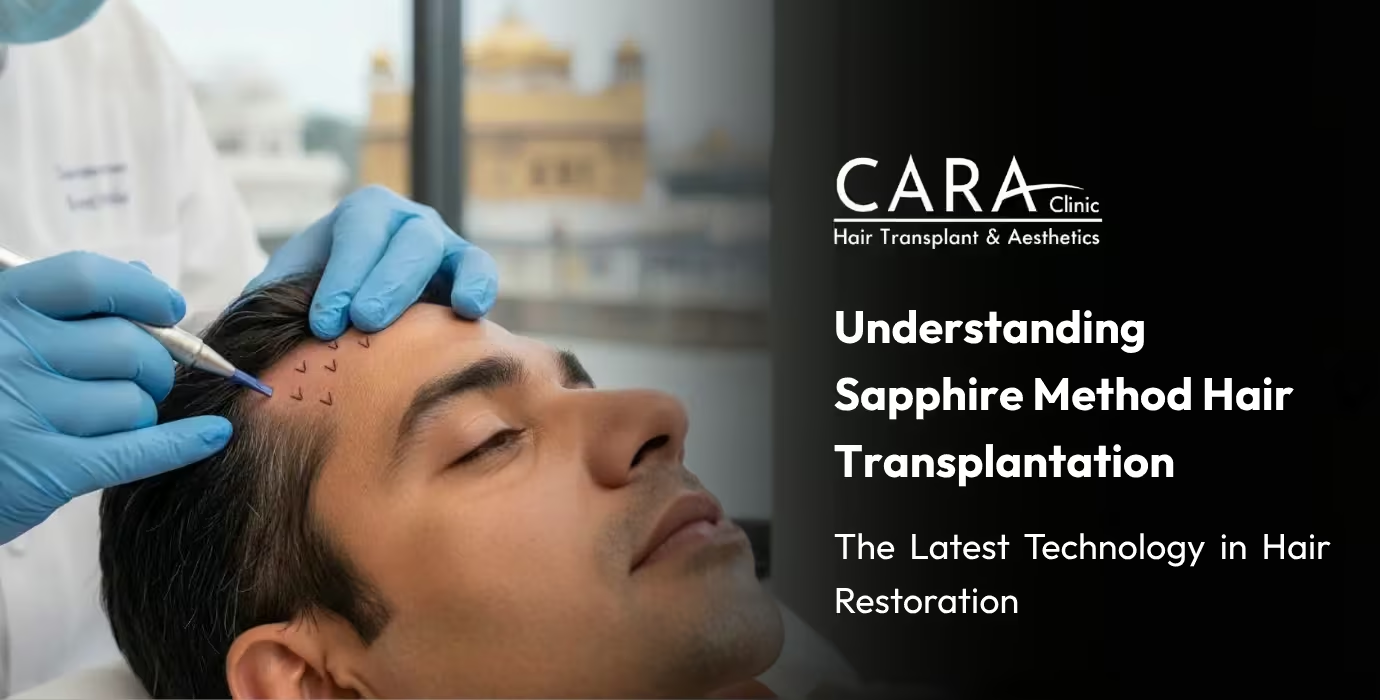
To go a step further in accuracy, some surgeons use sapphire blades combined with the Direct Hair Implantation technique. This is called the DHI sapphire method. In this case, grafts are loaded directly into a pen-like implanting instrument equipped with a sapphire tip.
Consequently, channel creation and graft placement become a single action performed at once instead of two separate procedures. Thus, greater control of the depth, angle, and direction of implantation becomes possible, especially in the case of frontal hairline restoration and revision of old transplantation.
Is DHI Sapphire Method Suitable for You?
All patients do not require the DHI Sapphire method, and an honest clinic will never try to impose this treatment on you as something inevitable. DHI is usually indicated for patients:
◉ Requiring dense coverage in a small and prominent area
◉ Having a narrow donor reserve and leaving no margin of error
◉ Recovering from failed old transplantation
◉ Wishing to have a short procedure with minimal shaving of the scalp
At Cara Clinic, the appropriateness of the DHI Sapphire technique will depend on your own pattern of hair loss and donor site.
Why You Should Select Cara for Sapphire Method Hair Transplant
There are lots of clinics that use the word “sapphire” in the pricing list without performing it at the operational stage. The method, though similar to the normal FUE, demands precise work with far more caution and care.
The founders of Cara Clinic introduced Sapphire FUE in India and personally conduct each procedure with precision. When it comes to choosing a Sapphire method hair transplant, our doctors provide 10+ years of expertise and years of trust.
FAQs on Sapphire Method Hair Transplantation
How is the Sapphire method different from regular FUE?
The procedure of extracting follicles is identical for both Sapphire and FUE procedures. But the uniqueness lies in the sharp and sturdy edge of Sapphire compared to steel.
Is Sapphire hair transplant surgery painful?
It is carried out under local anesthesia. So, there is no pain during extraction and implantation, although some discomfort might appear.
How many grafts do I need?
The answer depends on the stage of hair loss and the density of the donor area. 500 to 1,000 grafts may be sufficient for a receding hairline, whereas 2,500 grafts or even more might be needed to overcome a more serious degree of balding.
When can I expect results?
It will take around 6 to 12 months to see the complete result of Sapphire technology hair transplant as the follicles mature. Initially, some transplanted follicles may shed, and it is natural.
Would the Sapphire technique of Cara Clinics be appropriate for advanced stages of baldness?
In most cases, yes, as advanced cases can normally be treated using a combination of the Sapphire FUE and the DHI Sapphire techniques with precision. Get a proper consultation from the Cara Clinic experts to know about it in detail.
Wanted to Know More About Sapphire Method Hair Transplantation
Medicaly reviewed by
Author: DR. Mohd Asif
MBBS | MD – Dermatology | Dermatologist
Founder &Director – Cara Clinic, Santacruz(W), Mumbai
15+ Years of Experience in Sapphire FUE Hair Transplant, Hair Loss Therapy, Hair Restoration, Aesthetic Treatments, & Non-Invasive Solutions.
References:
– https://hmhaartransplantatie.com/en/understanding-sapphire-hair-transplantation-the-latest-technology-in-hair-restoration/
– https://mymaxhair.com/all-you-should-know-about-sapphire-hair-transplant-dhi-method/