The choice between GFC vs PRP hair treatment in Mumbai depends on the stage of hair loss and how many hair follicles you still have. Both these treatments start with your blood but handle it differently. Neither of them can bring back hair reliably if the hair follicles have already completely gone. Read on for a plain comparison you can actually take to your consultation.
Choosing Between GFC vs PRP Hair Treatment in Mumbai
It is more important that you have realistic expectations rather than which name of the treatment you go for. If you still have plenty of hair follicles (although weak ones) in your scalp, a doctor can recommend either one of these treatments after checking your scalp and your medical history.
As for the treatments, GFC concentrates specific growth factors, while PRP keeps a broader mix of blood components. That difference can affect how many sessions you book and how your scalp feels afterward. Once you see the details, GFC vs PRP Hair Treatment in Mumbai stops feeling like a coin toss.
Looking for the GFC vs PRP Hair Treatment in Mumbai?
GFC vs PRP Treatment for Hair Loss
PRP and GFC procedures are often lumped together, but they’re not the same. Take a look at each one first, then at how they stack up.
◉ How GFC Therapy Supports Weakened Hair Follicles
GFC Hair Treatment (Growth Factor Concentrate) is a concentration of growth factors harvested from your own blood and injected into the scalp to stimulate weak follicles for a thicker and fuller head of hair in thin areas.
◉ How PRP Therapy Uses Platelet-Rich Plasma
PRP (platelet-rich plasma) is a concentration of platelets taken from your blood and used to stimulate the hair follicles and increase blood supply to the scalp.
Differences in Blood Processing and Growth Factor Preparation
In a GFC vs PRP treatment for hair loss, both procedures begin with a simple blood draw from your arm. A centrifuge then spins that blood, and GFC pulls out specific growth factors while PRP keeps more.
◉ Suitability for Early-Stage Hair Thinning
When assessing if non-surgical hair restoration therapy is appropriate, your doctor will take the severity of your hair loss into consideration. If you have only experienced early thinning, which may mean that your follicles are weak but still there, then either treatment is likely to be effective.
◉ Treatment Considerations for Moderate Hair Loss
If you have moderate loss across a wider part of your scalp, with areas that have active follicles, then your injections may be administered specifically to the hairline, temples or crown of your scalp, depending on where it is thinning.
◉ Factors That Influence Results in Advanced Hair Loss
If your doctor observes that you have progressed to advanced loss with smooth bald patches and no follicles, then neither treatment would be able to regrow hair, and they will recommend other options, such as a hair transplant in Mumbai.
◉ Expected Sessions and Follow-Up Requirements
Expect about 3 to 6 GFC sessions, spaced 4 to 6 weeks apart, depending on your response. PRP usually runs 3 to 4 sessions about a month apart, plus check-ups to see how you’re doing.
◉ Possible Side Effects and Recovery Considerations
After either one, mild redness, tenderness, swelling, or bruising might hang around for a few days. Infection is rare, but clean, sterile conditions and following aftercare advice still make a real difference. The table below shows comparison between GFC and PRP in terms of preparation, comfort, sessions, and results.
| Factor |
PRP |
GFC |
| What is injected |
Platelets plus plasma |
Purified growth factors only, with no blood cells |
| Blood processing |
Blood is spun in a centrifuge to concentrate platelets |
Special tubes activate platelets and extract growth factors |
| Growth factor concentration |
Moderate |
Higher |
| Discomfort |
Mild to moderate |
Usually minimal |
| Inflammation and swelling |
Possible for few hours |
Generally lower |
| Typical sessions |
4 to 6 |
3 to 4 |
| Speed of results |
Gradual, with visible thickness around 4 to 6 months |
Faster, with less shedding in about a month and better density by 3 to 4 months |
| Cost per session |
Generally lower |
Generally higher, though fewer sessions may narrow the gap |
| Research behind it |
Larger body of studies |
Newer, with less long-term data |
| Often preferred for |
Early thinning, tighter budgets |
Active thinning, sensitive scalps, fewer visits |
How Does Your Hair Loss Stage Influence Treatment Choice?
Your hair loss stage usually nudges the decision one way or the other. Still, a good doctor looks at several things at once, not just one.
◉ Stress, hormonal changes, or medical treatment can drive hair loss, and the cause shapes what a doctor recommends.
◉ Severity matters too, since early thinning and advanced loss rarely need the same plan.
◉ Both treatments need follicles that are active or dormant, because bare skin has nothing left to wake up.
◉ An active scalp infection can make PRP less suitable, so the doctor checks your scalp first.
◉ Your medical history counts as well, since both treatments use your blood and some conditions affect that.
◉ If you’ve tried other treatments before, how your hair responded helps the doctor plan the next steps
One thing never changes; neither treatment can reliably regrow hair where follicles no longer exist.
What Should You Expect During GFC and PRP Hair Treatment?
Walking in without knowing the steps can make anyone a little nervous. So here’s what a typical visit looks like, from the first chat to the follow-ups.
◉ Preparing for Your Initial Hair and Scalp Assessment
If you are new to hair restoration, make sure to come prepared and avoid blood-thinning meds for at least a week before. During this visit, you will talk about your hair restoration history and plans and go over your medical history.
◉ Understanding the Procedure and Injection Process
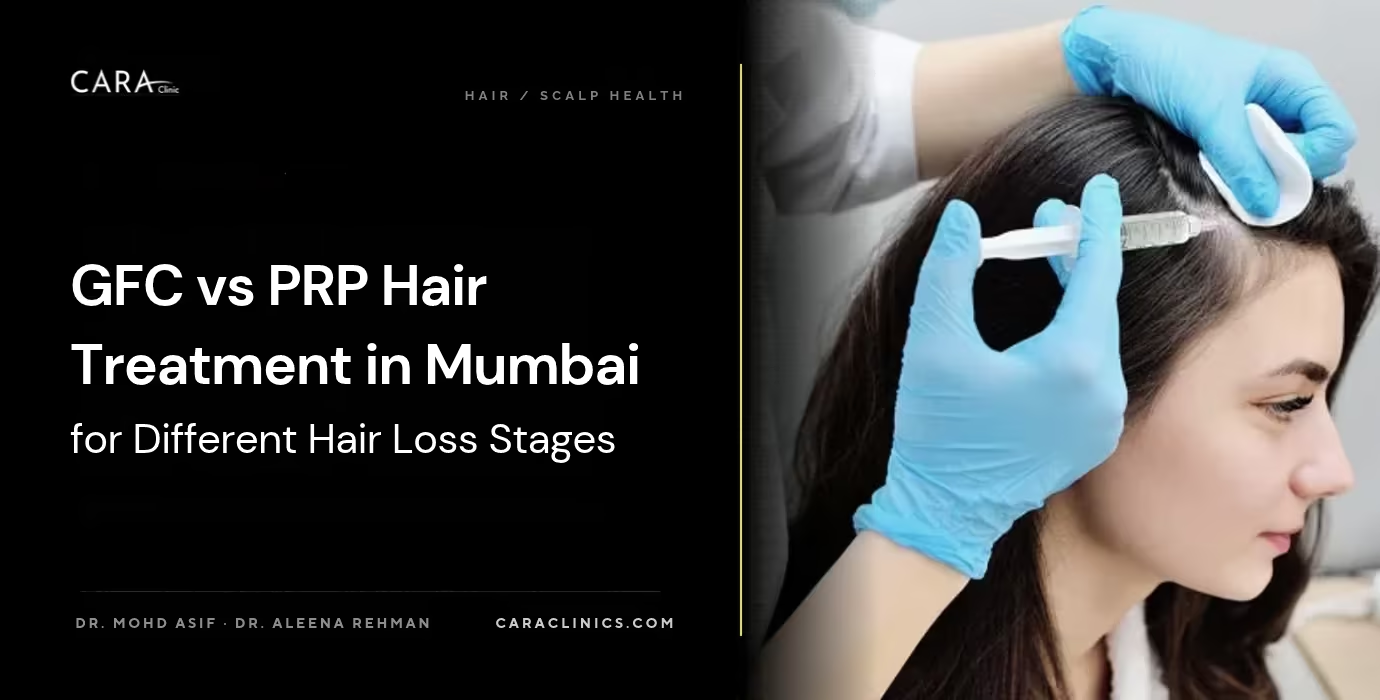
During a hair PRP treatment, or GFC, the doctor draws blood from your arm and spins it in a centrifuge. They numb your scalp to prepare for injection into the thinning areas with fine needles.
◉ Monitoring Hair Density and Changes Over Time
You might notice less shedding within a few weeks, but real thickening often takes three to six months. Follow-up visits matter during that wait, because the doctor tracks progress and decides if more sessions help.
◉ Planning Maintenance Sessions and Ongoing Hair Care
The effects of GFC hair treatment: Provides quick initial stimulation, requiring 3 to 4 initial sessions (spaced a month apart) and maintenance sessions every 4 to 6 months.Remember to follow some aftercare tips, like using a gentle sulfate-free shampoo, preventing the scalp from sun exposure, and not washing your hair for at least 24 hours.
◉ PRP: Clinical studies (such as comparative evaluations referenced on PubMed) indicate that PRP can demonstrate superior hair diameter and aesthetic scores at the 6-month mark, showing greater long-term durability. It typically requires 4 to 6 initial sessions and maintenance every 3 to 4 months
Why Choose Cara Clinic for GFC vs PRP Hair Treatment in Mumbai?
Choosing between GFC vs PRP Hair Treatment in Mumbai can only be done after proper doctor consultation and evaluation of the patient. At least, that is what the doctor set the expectations from day one Here at Cara Clinic, our doctors will best assess your scalp and hair loss and suggest whether you need GFC or PRP. Get in touch with us to know more.
FAQs on GFC vs PRP Hair Treatment in Mumbai
How do you choose between GFC vs PRP Hair Treatment in Mumbai for your hair loss stage?
Start with a scalp check, because GFC vs PRP Hair Treatment in Mumbai depends on the patients individual hair loss condition.Mild thinning often suits either one, while bare patches may call for a different approach.
Can non-surgical hair restoration help prevent further hair thinning?
Non-surgical hair restoration like PRP can help slow thinning, since it strengthens follicles that are still weak. Earlier is better, because there are more follicles left to work with.
When might a hair transplant in Mumbai be considered instead of GFC or PRP?
When bald areas have no follicles left, a hair transplant in Mumbai may make more sense than GFC or PRP. Your doctor can confirm that after checking your scalp and hearing your goals.
What should you avoid before and after GFC Hair Treatment?
Before GFC Hair Treatment, skip blood-thinning medicines like aspirin or ibuprofen for at least a week. Afterwards, wait 24 hours before washing your hair, and avoid direct sun, saunas, and heat for a few days.
Can Hair PRP Treatment be combined with other hair loss therapies?
Yes, Hair PRP Treatment is commonly used as a supportive therapy after a hair transplant. For anything beyond that, your doctor should choose the combination based on your scalp health
Key take away
Never basis choose
1)Speed of onset
2)Number of sessions
3)Advance or next generation positioning
4)Superiority is not a claim that we make- in consultation,website, instagram .
Looking for the GFC vs PRP Hair Treatment in Mumbai?
Medicaly reviewed by
Author: DR. Mohd Asif
MBBS | MD – Dermatology | Dermatologist
Founder &Director – Cara Clinic, Santacruz(W), Mumbai
15+ Years of Experience in Sapphire FUE Hair Transplant, Hair Loss Therapy, Hair Restoration, Aesthetic Treatments, & Non-Invasive Solutions.
References:
Sources:
– https://caraclinics.com/prp-treatment-face-cost-worth-it-what-to-expect/
– https://jdcronline.org/article/prp-vs-gfc-a-comparative-study-on-efficacy-and-patient-satisfaction-in-hair-loss-treatment-516/