Hair thickening does not necessarily have to come at the expense of scalp health, but some hair thickening techniques will. Hair weave vs hair transplant is a frequent comparison due to the promise of thickened hair from both procedures. The difference between the two lies in how one puts more hair on top of the scalp while the other implants hair under the scalp. Below, you will learn about the two processes in detail.
Hair Weaving vs Hair Transplant for Scalp Health
In weaving, more hair is added to your own hair. With hair transplantation, your own hair follicles are moved to bald areas. This means that both treatments put stress on your scalp in different ways.
So, before making your selection, compare hair weaving vs hair transplant to know the potential risks involved. You should first consider the tug at the roots, the healing period, and the maintenance requirements. Then, compare them with your situation.
Understanding Surgical vs Non-Surgical Hair Restoration Options
Both processes can help you look younger; however, they act in different ways. Here is how they both work and heal.
◉ How Hair Weaving Works Without Surgery
Weaving does not require any cuts or sewing whatsoever, but it depends on your natural hair being the glue that holds everything together. Secondly, hair stylists attach additional hair to your hair using sewing, bonding, or taping techniques. When comparing surgical vs non-surgical hair restoration, weaving is an additional hair added onto your own hair without making any incisions.
◉ How Hair Transplantation Restores Hair Growth
to thinning areas. For example, Sapphire FUE makes use of sapphire blades to transfer follicles with care. IMARC Group notes that surgical procedures accounted for 63% of India’s hair transplantation market in 2025.
◉ Scalp Irritation and Allergic Reactions to Hair Attachments
Glue, tapes, and bonding agents can cause skin irritation. Indeed, some people suffer from itching and redness caused by allergies, particularly when the weather is humid. However, in a transplant, there is no use of such products.
◉ Potential Scarring and Healing After Hair Transplant Surgery
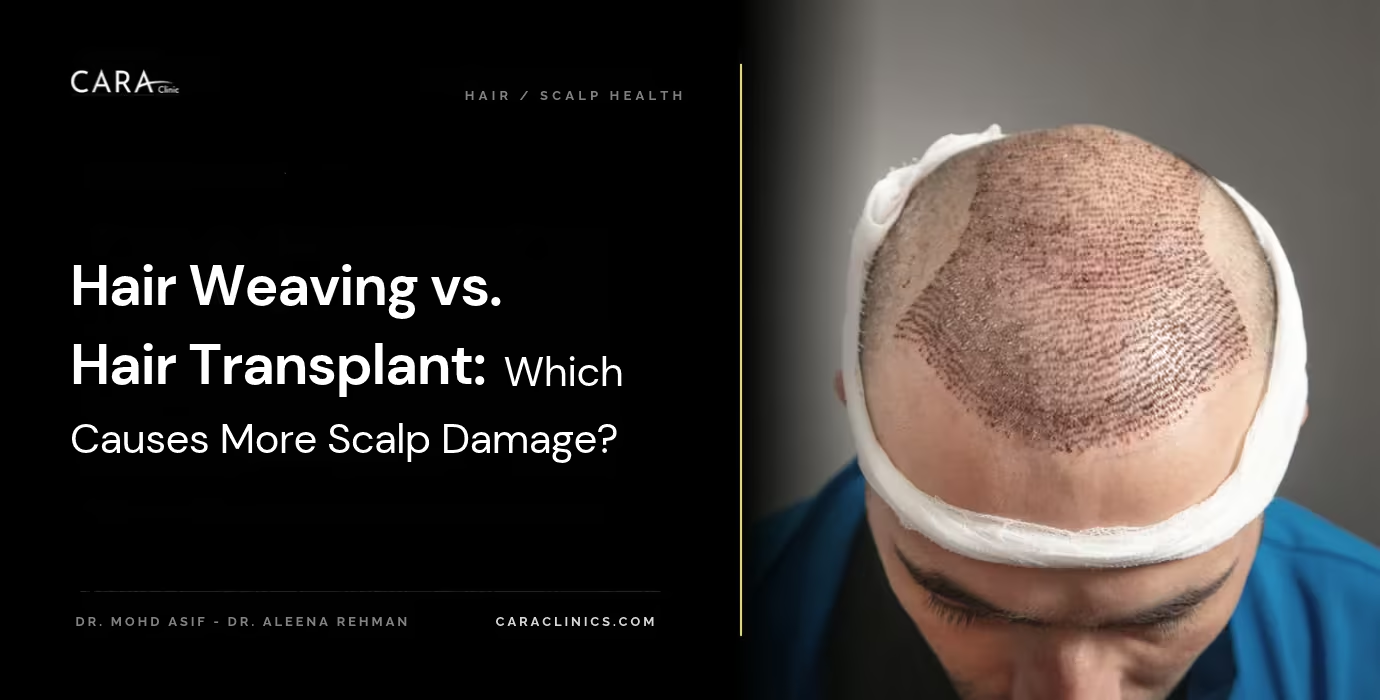
After a hair transplant in Mumbai, small dot marks and scabs can be visible early on. The FUE method uses follicles one by one; thus it does not leave the lengthy scar like the older method of strip surgery.
◉ Recovery Time and Long-Term Scalp Care
Most people find new growth six to twelve months post-transplant. In the meantime, the process of gentle cleaning and an aftercare routine by your doctor will ensure that your healing skin remains safe. Eventually, you will be able to wash, trim, and style the new hair just like your own.
Looking for the GFC vs PRP Hair Treatment in Mumbai?
Hair Weaving vs Hair Transplant and Their Impact on Scalp Health
Your scalp’s health depends on the option you choose, and each hair weaving vs hair transplant option comes with its own risks. Here is how the two compare on each point.
◉ Traction Alopecia Risk
Weave hairstyles apply traction to your roots daily, and excessive traction can result in traction alopecia that becomes irreversible when follicles become scarred. A hair transplant involves using your own hair follicles and does not exert any pulling force on the scalp; therefore, it is not associated with traction alopecia.
◉ Infection and Inflammation
The weaving process is associated with the possibility of irritation from adhesives, sweat, and dirt that could trigger inflammation. The danger for a donor is temporary and limited only to the period of recovery.
◉ Scarring and Tissue Trauma
Although weaving does not leave any surgical scars, over-tight stitching can harm the hair follicle and create scarring. However, transplant surgery leaves tiny scars at the donor sites, which will heal and be concealed by the hair.
◉ Long-Term Scalp Health
Woven results rely on the strength of attachment, the quality of materials, and scalp cleanliness. In contrast, transplant results rely mostly on the quality of donor hair and the skill of the surgeon.
◉ Maintenance and Scalp Impact
Weaving results will be determined by the tightness of the attachment, the quality of the hair used, and the cleanliness of the scalp. On the contrary, the results of transplantation will be largely determined by the quality of the donor hair.
◉ Suitability for Hair Loss Patterns
Out of hair loss solutions for men and women, weaving provides instant coverage regardless of the type of hair loss. Transplanting is recommended where hair loss is stable, and there is healthy donor hair available.
◉ Existing Scalp Conditions
Weaving will worsen an allergy problem, eczema,, or any other sensitivity due to the adhesives used. In the same way, transplanting needs a doctor to confirm there is no infection, autoimmune disease, or uncontrolled hair loss.
◉ Best Fit for Your Goals
Weaving will worsen an allergy problem, eczema, or any other sensitivity due to the adhesives used. In the same way, transplanting needs a doctor to confirm there is no infection, autoimmune disease, or uncontrolled hair loss. The table below summarizes how hair weaving and a hair transplant differ on the key scalp health factors.
| Factor |
Hair Weaving |
Hair Transplant |
| Traction alopecia risk |
Higher, due to daily pulling |
Not associated |
| Irritation or infection |
From adhesives, sweat, and dirt |
Temporary, during recovery |
| Scarring |
Possible if stitching is too tight |
Tiny scars, usually hidden |
| Maintenance |
Regular upkeep of the attachment |
Aftercare in the first few weeks |
| Best suited for |
Instant coverage, any hair loss type |
Stable hair loss with healthy donor hair |
What Should You Consider Before Choosing a Hair Restoration Method?
Before deciding what to choose between hair weaving vs hair transplant, take a step back and evaluate the following important factors. Be frank about your objectives, budget, daily schedule, and willingness for surgical procedures. Keep these key points in mind before you decide:
◉ Scalp health, such as allergies, sensitivity, irritation, and hair damage
◉ The pattern of hair loss and remaining donor hair quantity
◉ Setting realistic expectations with regard to results and how long it will take
◉ Maintenance, considering that a weave has to be tightened every couple of weeks, while healing hair doesn’t
◉ A check-up with an expert before beginning any treatment
An appointment at a reputable hair transplant clinic in Mumbai will allow you to make an informed decision.
Why Should You Consider Cara Clinic for Hair Weaving or Hair Transplant in Mumbai?
Weaving provides immediate coverage; however, it requires maintenance and tiring work on the scalp. Hair transplantation provides permanent coverage and growth where there is healthy donor hair.
Cara Clinic is a hair transplantation clinic located in Mumbai. We provide Sapphire FUE with no stitches and linear scar. Our starting price is ₹75 per graft. Solutions for hair loss problems for both males and females are provided. Book your appointment today.
FAQs on hair weaving vs hair transplant
1. How can you tell if a hair restoration method is damaging your scalp?
In hair weaving vs hair transplant, watch for persistent pain, redness, itching, tenderness, or thinning where hair is under tension, like the hairline and parting. Mild swelling and scabbing are normal in the first days after a transplant, while adhesive irritation is a common issue with weaves. See a doctor if symptoms last or worsen.
2. Which hair loss solutions for men and women are suitable for different types of hair thinning?
The correct type of treatment for male and female hair loss depends on the type of loss, the state of the donor hair, and your personal requirements. PRP therapy might be suitable if you have experienced early hair thinning, while a hair transplant is best when you experience steady loss with good donor hair.
3. What factors influence the recovery experience after a hair transplant in Mumbai?
Recovery depends on the number of grafts, aftercare practices, and the type of scalp. Hair transplantation in Mumbai will result in swelling for a few days, with the appearance of scabs in one to two weeks’ time. Shedding is followed by hair regrowth in three to four months.
4. What qualifications and safety standards should you check when choosing a Hair transplant clinic in Mumbai?
Ensure that the hair transplant clinic in Mumbai has certified doctors to examine and perform the surgery on you. There should be good standards of cleanliness, transparency in terms of charges and outcomes, and proper follow-up care.
5. Can repeated tension on the scalp cause permanent hair loss, and when should you seek medical advice?
Yes, chronic stress due to tight weaves or extensions can result in follicle scarring and lead to permanent traction alopecia. In early stages, the hair can grow back after removing the stress. Consult your doctor if you notice hair loss or tenderness.
Looking for the GFC vs PRP Hair Treatment in Mumbai?
Medicaly reviewed by
Author: DR. Mohd Asif
MBBS | MD – Dermatology | Dermatologist
Founder &Director – Cara Clinic, Santacruz(W), Mumbai
15+ Years of Experience in Sapphire FUE Hair Transplant, Hair Loss Therapy, Hair Restoration, Aesthetic Treatments, & Non-Invasive Solutions.
References:
– Hair Transplant in Mumbai
– https://www.fusehair.com/blog/hair-transplant-vs-hair-patch.htm
– https://www.harleyshairtransplant.in/blogs/hair-patch-vs-hair-transplant-pros-cons-and-cost-comparison